
Timber sale targets fall again as key DNR operating fund drops from $20 million to $5 million
The Washington Department of Natural Resources’ (DNR) growing budget shortfall is being made significantly worse by continued reductions in timber harvests on state trust lands, driven by unilateral policy decisions from Commissioner of Public Lands Dave Upthegrove.
Under Washington’s constitution and state law, state trust lands are required to be managed to generate revenue for defined beneficiaries, including public schools, counties, fire districts, libraries, and other essential public services. For decades, sustainable timber harvests on these public working forests have provided critical non-tax revenue, while also supporting family wage jobs, rural economies, recreation, and clean air and water through responsible, science-based forestry.
Yet DNR recently reduced its projected timber sale volume again, cutting planned sales from 580 million board feet to 440 million board feet, a 24 percent reduction since July 1. These reductions are occurring as state lawmakers grapple with difficult budget decisions and consider tax increases to balance the state budget.
“These policy decisions have real, immediate consequences for DNR’s financial health, for schools and local services, for rural economies and for the state budget as a whole,” said American Forest Resource Council (AFRC) President Travis Joseph. “Legislators should be asking why the state’s own land management agency is making the situation worse. Further reductions in timber harvests will mean less funding for local public services, while increasing pressure on the state budget and taxpayers to keep the Department solvent and prevent layoffs of DNR employees.”
New data, presented by DNR to the Board of Natural Resources shows that DNR’s Forest Development Account, which receives a share of the revenue DNR generates and helps fund agency operations, staffing, and silviculture, has fallen from approximately $20 million to about $6 million today. This decline will only get worse as timber sale volumes continue to decrease and expenditures outpace revenue. As timber revenue falls, DNR’s ability to manage forests, fund staff, and carry out its own mission is increasingly constrained.
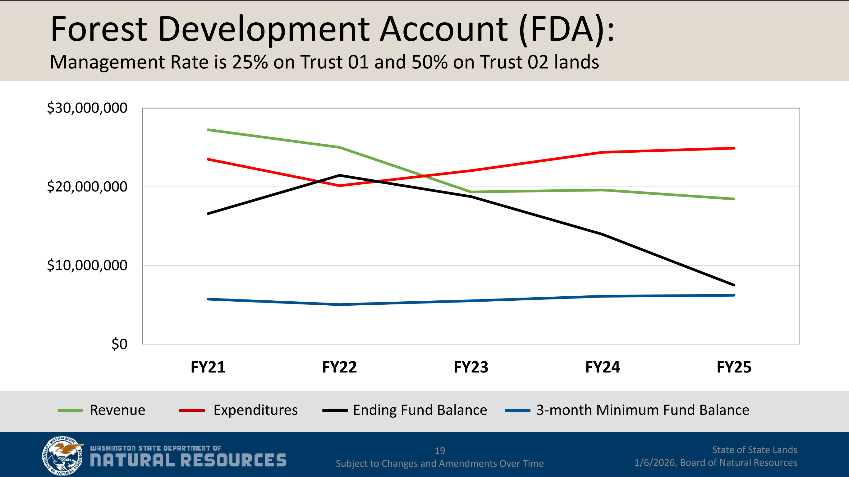
AFRC has warned that Commissioner Upthegrove’s unilateral 77,000 acre set-aside of state trust lands, combined with a nearly 8-month timber sale pause and ongoing efforts to withdraw individual sales, is compounding the problem.
The 77,000-acre set aside alone could result in more than $2 billion in lost revenue over time, or roughly $110 million per year that would otherwise support school construction, county services, fire and emergency response, libraries, road maintenance, and DNR management accounts.
Despite the mounting fiscal consequences, Commissioner Upthegrove has made clear that he intends to further reduce timber harvests in favor of carbon offsets and other ecosystem service markets. During a January 14 Clark County Council meeting, Upthegrove said that passage of HB 2170, DNR’s ecosystem services legislation, would give him the “flexibility” to shift harvestable state trust lands into carbon markets.
Upthegrove has acknowledged that these markets generate only “pennies on the dollar” compared to sustainable timber harvests, a shift AFRC warns would deepen revenue losses for trust beneficiaries, further destabilize DNR’s finances, and hurt rural communities. During a January 28 hearing on HB 2170, beneficiaries, including schools, counties, and others, testified in strong opposition to the bill.
AFRC urged legislators to exercise meaningful oversight as these decisions move forward, noting that the Board of Natural Resources is scheduled to receive updates on DNR’s management accounts and an updated economic forecast at its March meeting.
With the State of Washington, along with many counties and taxing districts, facing serious budget challenges, it is essential that the Board fully assess the real fiscal consequences of arbitrary harvest reductions and ensure DNR is doing everything in its power to generate non-tax revenue for trust beneficiaries by selling the timber already planned under its Sustainable Harvest Calculation.