
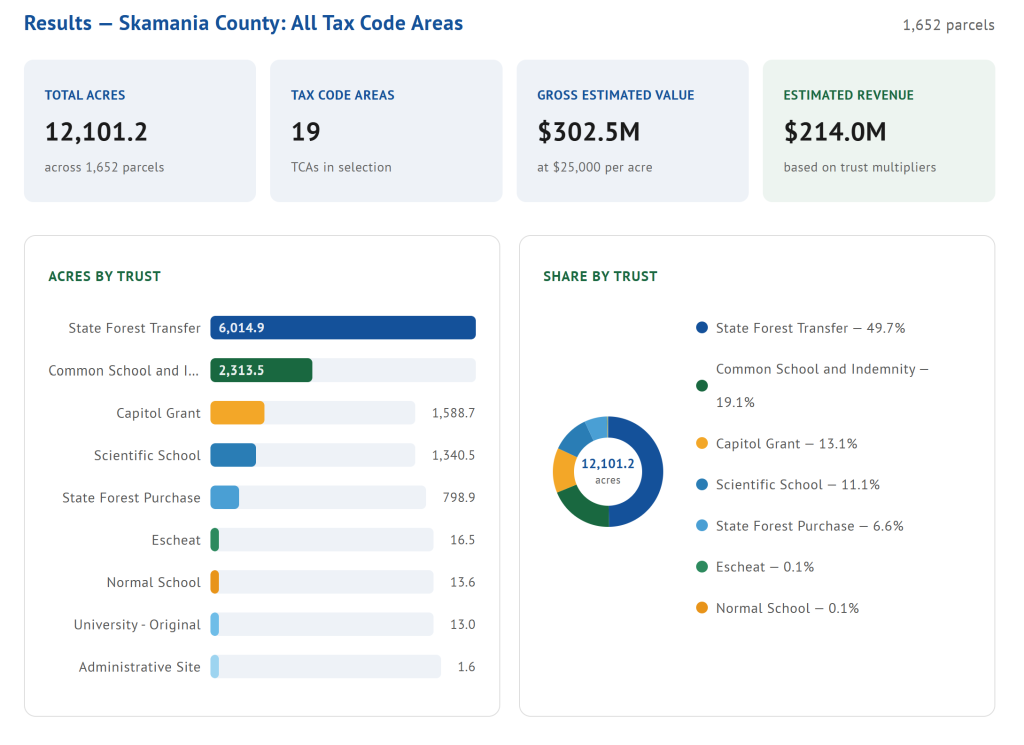
The American Forest Resource Council today announced the availability of a new public on-line tool, the “77,000 Acre Commissioner Order – Community Impact Calculator,” providing Washington communities and trust beneficiaries with a detailed look at the impacts of Commissioner Dave Upthegrove’s order to layoff nearly 80,000 acres of state trust lands from working status.
The calculator, available through the Washington Communities and Schools Network, allows users to identify affected acres by county and trust and better understand the implications for schools, counties, fire districts, and other local services that depend on timber revenues from state trust lands. The calculator is based on the latest GIS data released by the Department of Natural Resources (DNR) in January.
The information comes as timber sales from state trust lands have already fallen to a 22-year low, putting both trust beneficiaries and the DNR at serious financial risk.
State trust lands are held in trust for defined beneficiaries, including public schools, counties, fire districts, libraries, and other essential public services. These lands are working forests that generate revenue, support jobs, and provide Washington made wood products used in housing and infrastructure across the state.
“The Commissioner’s order, made unilaterally without Board input or approval from the Washington Legislature, amounts to a regressive tax system imposed on rural communities and working families,” said AFRC President Travis Joseph. “We hope this tool will help inform the public and decision-makers about the real-world impacts to students, teachers, fire districts, hospitals, libraries, and other critical services in the hardest-hit communities.”
The data shows that 79,876 acres of state trust lands are included in the Commissioner’s order, not 77,000 acres as previously described, with the largest share of impacts falling on lands that generate revenue for counties and essential local services like schools and fire districts.
Of the acres identified, more than 36,000 acres are State Forest Transfer lands and more than 5,200 acres are State Forest Purchase lands, both of which are intended to benefit counties and essential local services. County trust lands account for nearly 17,000 more affected acres than Common School trust lands, which support K-12 school construction statewide.
The impacts are concentrated in rural counties where trust land revenue plays an outsized role in funding local services and local economies.
In Skamania County, more than 12,100 acres are included in the set aside, including over 6,000 acres of the county’s State Forest Transfer lands. Prior DNR analysis identified roughly 10,400 acres of operable State Forest Transfer lands in the county after past habitat set asides. This order would remove nearly 60 percent of the remaining land base available to generate revenue for Skamania County services.
Based on the data, Skamania County would lose an estimated $123 million in DNR timber revenues over the next two decades, including approximately $112.8 million from State Forest Transfer lands and $10 million from State Forest Purchase lands., These revenue losses would further cripple key public services in Skamania County, compounding large cuts to public services due to previous reductions in timber revenues from state and federal lands.
In Clallam County, more than 9,300 acres are included in the dataset, including approximately 4,664 acres of State Forest Transfer lands. In a March 2 letter to state leaders, the Clallam County Revenue Advisory Committee called for legislative oversight of trust land management and cited withheld timber sales and reduced revenue for local services. The committee emphasized that these lands are held in trust and that revenue from timber sales is intended to support counties and junior taxing districts. Estimated losses of State Forest Transfer revenue from the Commissioner’s order include $12.6 million for the Quillayute Valley School District and $3.4 million for the Port Angeles School District.
“This tool gives the public and trust beneficiaries a clear picture of what this order means on the ground,” Joseph said. “These lands are held in trust for defined beneficiaries, and the impacts fall directly on counties, local services, and ultimately, working families. The Legislature and the Board of Natural Resources have a responsibility to review these decisions and ensure the trust is managed in a way that reflects its purpose.”
Reductions in DNR harvest levels also reduce harvest excise tax collections that support counties and local taxing districts, compounding the financial impacts to local communities.
Washington’s state trust lands are part of the state’s working forest base. Timber harvest on these lands supports jobs, keeps mills operating, and sustains the forest products supply chain that allows Washington to produce locally grown wood products. Changes to the land base available for management affect revenue, forest management capacity, and the long term stability of this system.
AFRC encouraged state and local leaders, as well as the public, to use the Community Impact Calculator to better understand how the Commissioner’s order affects their communities and to evaluate the potential impacts to trust beneficiaries across Washington.