
A study published in the journal National Science Review concluded that timber harvesting targeted on forests nearing the end of their productive growth periods can simultaneously increase forest carbon stocks and increase timber production. Conversely, the study indicates that low-intensity harvesting reduces carbon sequestration potential by promoting forest aging and mortality. The study’s findings ultimately challenge the widely held assumption that minimizing harvesting maximizes carbon sequestration.
These conclusions are based on the fact that forests sequester carbon at higher levels during their most vigorous growth periods. In western conifer forests, those periods tend to occur at younger and middle-ages and begin to decline as forests reach maturity. Harvesting trees at the beginning of the mature phase allows land managers to capture stored carbon in long-lasting wood products and reforest harvested acres with young trees capable of maximizing carbon sequestration again. The graph below illustrates this concept well:
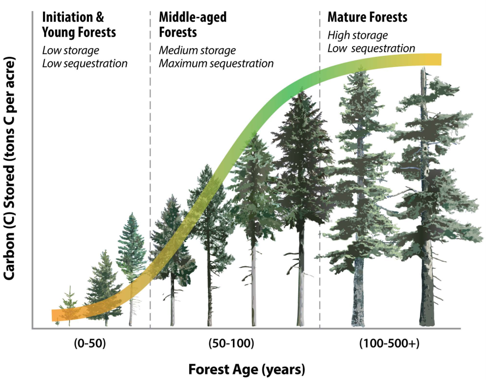
The study echoes the concept illustrated in the image above by concluding that maintaining forests in more productive age classes, reducing mortality losses, and transferring carbon into long-lived wood products, delivers a net climate mitigation benefit.
It also builds on this forest growth concept and stresses that forest aging and associated mortality represents a critical but often overlooked driver of carbon loss and challenges the notion that increased harvesting leads to greater atmospheric carbon release. Instead, timber harvesting can enhance the retention of carbon loss across both living biomass and wood-product pools. /Andy Geissler